Stepping Stones to the Stars by Treadwell Terry C
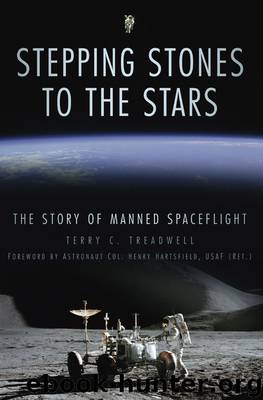
Author:Treadwell, Terry C
Language: eng
Format: epub
ISBN: 9780752496788
Publisher: The History Press
Published: 2013-05-07T04:00:00+00:00
CHAPTER SIX
THE DEVELOPMENT OF THE SPACE SHUTTLE
After the success of the Mercury, Gemini, Apollo and Skylab missions, and the excitement of men walking on another world had died down, the space programme in America suddenly appeared to come to a standstill.
A great deal of thought had been given to the cost and the waste of materials that constituted the launch of the Mercury, Gemini and Apollo spacecraft. From the massive rocket that left the launch pad, all that returned to Earth was the tiny capsule that had been perched on top. The majority of the remaining parts of the rocket burnt up on re-entry, but some pieces became part of the massive junkyard that circled the Earth. However, NASA had not been idle: since the beginning of the 1960s they had been carrying out experiments with lifting bodies. These were small wingless aircraft equipped with a rocket motor, which were dropped from a converted Boeing B-52 bomber. The object of the exercise was to see if a re-usable spacecraft could be developed that could manoeuvre in space and then land back on Earth.
NASA had also been carrying out tests in 1963 using the North American X-15 rocket plane, taking the aircraft to heights and speeds never before experienced. At one time twelve test pilots, including Neil Armstrong, Forest Peterson and Scott Crossfield, carried out 199 flights, finally reaching altitudes of 98,800m (324,200ft) and speeds of 4,520mph (Mach 6.7). This took the aircraft virtually into space where it behaved much like a Mercury space capsule using small jets in the nose and, in the case of the X-15, in the wingtips, to control the pitch, roll and yaw. It was the use of small jets like these that was to later enable the Space Shuttle Orbiter to manoeuvre whilst in space.
The research aircraft were designed to withstand temperatures of 1,200°F, but on a number of occasions this was exceeded and temperatures of 2,000°F were recorded. These aerodynamic heating investigations also helped to create a new glass for the windshield. Originally the glass was made of a soda-lime mixture, but this failed on a test flight and a new windshield, made of alumino-silicate, was created. The X-15 provided invaluable information for pilots of very high-speed aircraft concerning the control surfaces and their reaction under high-speed stress and temperatures.
Download
This site does not store any files on its server. We only index and link to content provided by other sites. Please contact the content providers to delete copyright contents if any and email us, we'll remove relevant links or contents immediately.
Whiskies Galore by Ian Buxton(42154)
Introduction to Aircraft Design (Cambridge Aerospace Series) by John P. Fielding(33244)
Small Unmanned Fixed-wing Aircraft Design by Andrew J. Keane Andras Sobester James P. Scanlan & András Sóbester & James P. Scanlan(32873)
Aircraft Design of WWII: A Sketchbook by Lockheed Aircraft Corporation(32382)
Craft Beer for the Homebrewer by Michael Agnew(18342)
Turbulence by E. J. Noyes(8201)
The Complete Stick Figure Physics Tutorials by Allen Sarah(7476)
The Institute by Stephen King(7151)
The Thirst by Nesbo Jo(7097)
Kaplan MCAT General Chemistry Review by Kaplan(7051)
Bad Blood by John Carreyrou(6727)
Modelling of Convective Heat and Mass Transfer in Rotating Flows by Igor V. Shevchuk(6532)
Weapons of Math Destruction by Cathy O'Neil(6465)
Learning SQL by Alan Beaulieu(6402)
Man-made Catastrophes and Risk Information Concealment by Dmitry Chernov & Didier Sornette(6217)
Permanent Record by Edward Snowden(5954)
Digital Minimalism by Cal Newport;(5919)
Life 3.0: Being Human in the Age of Artificial Intelligence by Tegmark Max(5685)
iGen by Jean M. Twenge(5508)
